Sorting the olives
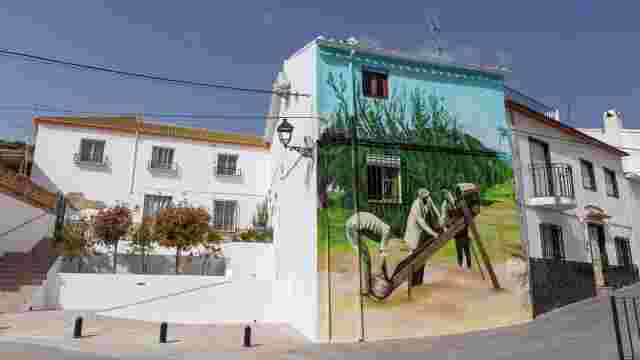
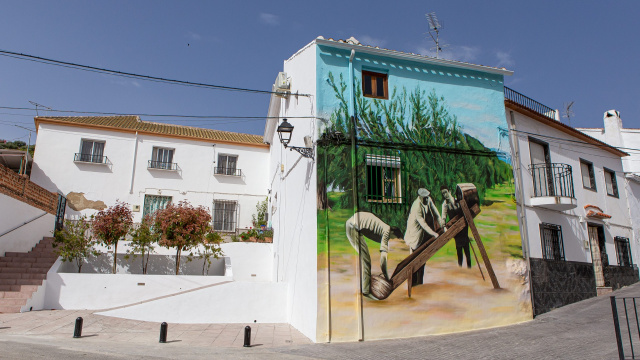
Several olive pickers can be seen sifting through the olives. When the baskets are full, they are emptied onto the sieve (the elongated object depicted in the mural, shaped like a slide), which separates the olives from impurities (leaves, twigs, soil and stones). The aim is for the olives to arrive at the oil mill as clean as possible so they can be pressed. The buckets of olives are tipped over at the top and, by the force of gravity, the olives roll down whilst the leaves and soil fall through the slits. At the end, the sieve narrows, ending in a funnel shape, and this is where the sack is placed to be filled with the selected olives. Once full, it is tied with a rope and loaded onto the tractor, ready to be taken for pressing. This artwork beautifully captures the local customs and history of the Fuente-Tójar area, where most families used to (and still do) go out to harvest the olives. The mural is rendered in a figurative style, aiming for a certain degree of realism in the forms, though not to excess. It depicts various elements of the countryside, such as olive trees, wild olive trees, sieves and olives, using a blue background that helps to unify the image.